

Smart Ways to Secure a Low APR
Understanding used car loan interest rates can help you choose the right vehicle and save thousands over the life of your loan. Your final APR is shaped by your credit score, loan term, down payment, vehicle age and mileage, and lender type. Knowing how these parts work together makes it easier to compare offers and select the best fit for your budget. This page explains how used auto APRs are set, the difference between rate and APR, how to estimate payments, and proven strategies to qualify for better terms. You can also explore helpful tools like payment calculators and financing resources, learn about pre approval, and see how market trends influence rates. If you are researching models with the best value, we link to curated shopping guides and inventory pages so you can align a comfortable payment with the right vehicle.
Keep reading to learn how lenders price risk, what documents you will need, the impact of trade in value, and how to avoid common financing mistakes when buying a used car.
Used auto loan APRs change with the market, credit profile, and vehicle details. Compare quotes across banks, credit unions, online lenders, and dealership financing to confirm the best fit for your budget. Review resources such as payment options and pre approval tools, then match your comfort level with vehicles in stock. The guides below will help you prepare documents, understand fees, and plan a smart down payment before you choose a car.
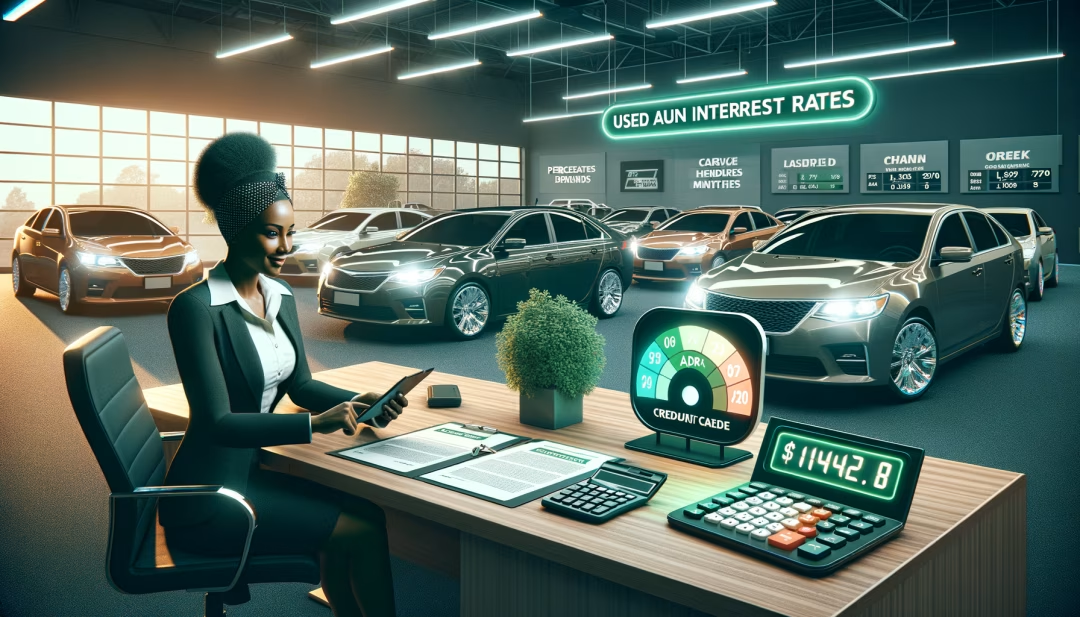
What are used car loan interest rates and APR
An interest rate is the base cost of borrowing money. APR, or annual percentage rate, includes the interest rate plus certain lender fees expressed as a yearly cost. APR is the best number to compare loan offers because it reflects more of the true borrowing cost. Most used auto loans have fixed APRs, which means the rate does not change over time.
How lenders set your used auto APR
Lenders price loans based on risk. Risk increases when a borrower has limited credit history, lower scores, higher debt, a very long term, minimal down payment, or a vehicle with higher mileage. Risk decreases when the borrower has strong credit, stable income, a shorter term, and a solid down payment or trade equity. Vehicle age and type matter too. Many lenders place tighter caps on older models or very high mileage vehicles.
- Credit score and history influence your tier and base rate. Learn more at what-credit-score-is-needed-to-finance-a-used-car.
- Loan term affects interest cost. Shorter terms usually have lower APRs and less total interest paid.
- Down payment and trade value reduce the amount financed and can qualify you for better pricing. See value-my-trade.
- Lender type matters. Credit unions often post competitive used APRs. Compare with dealership and online lenders.
- Market conditions move rates up or down. Explore trends at how-interest-rates-affect-used-car-loans and used-car-market-trends.
Strategies to lower your used car loan APR
A few targeted steps can significantly improve your approval odds and rate. Focus on credit hygiene, right size your budget, and compare multiple quotes on the same day to limit credit score impact.
- Check credit reports for errors and pay down revolving balances before you apply. See how-to-get-approved-for-a-used-car-loan.
- Target a shorter term that still fits your monthly budget. Use tools at payment-options to model payments.
- Increase your down payment or trade equity to lower risk and reduce interest cost over the life of the loan.
- Limit add ons that roll into the loan if they do not provide clear value, since they increase principal and total interest.
- Compare offers from at least three lenders on the same day. Use soft pull pre qualification when available to reduce score impact.
APR versus interest rate and fees
Two loans can share the same interest rate but produce different APRs due to fees such as origination or documentation charges. APR provides a more complete comparison. Still, look at both the APR and the total of payments to see how term length changes total interest. If you plan to pay off the loan early, confirm whether the lender has prepayment penalties.
Example used car payment scenarios
Here is a general illustration. A 20000 used vehicle financed for 60 months at 7.5 percent APR with 3000 down typically lands near a mid 300 monthly payment. Extend the term to 72 months and the monthly payment drops, but the total interest paid rises. Increase the down payment by 2000 and your monthly payment and total interest both decrease.
- Shorter term equals higher monthly but lower total interest.
- Longer term equals lower monthly but higher total interest.
- Higher down payment reduces principal and interest cost.
Compare lender types
Banks, credit unions, online lenders, and dealership financing each offer advantages. Credit unions may post attractive used APRs for members, banks provide broad availability, online lenders simplify comparison, and dealerships can match or beat rates with promotional options. Request quotes with the same term and down payment for an apples to apples comparison. If you receive a pre approval from a third party, ask the dealer to try to beat or match it.
Pre qualification versus pre approval
Pre qualification is usually based on a soft credit pull and estimates your potential APR and payment range. Pre approval is a firmer commitment that uses a hard pull and may lock your rate for a short window. Both can help you shop inventory with confidence. Explore tools at applications and read how-to-finance-a-used-car for a step by step overview.
Fixed versus variable rates
Most used car loans are fixed APR loans, which means your monthly payment stays the same. Variable rates are uncommon for used auto financing and can change with the prime rate. A fixed APR provides predictability and makes budgeting easier across the term of your loan.
Refinancing a used car loan
If market rates fall or your credit improves after purchase, refinancing can lower your APR and monthly payment. Refinancing works best when you have made on time payments for at least six months, your vehicle retains strong value, and you do not extend the term so far that you increase total interest dramatically. Review the process at how-to-refinance-a-used-car-loan.
Documents and verification
Prepare proof of identity, proof of income, proof of residence, insurance information, and trade in title or payoff details. Lenders verify employment and may ask for bank statements. Having documents ready speeds approval and can help you secure a better rate because it lowers friction and uncertainty in underwriting.
- Government issued ID and Social Security number for identity verification.
- Recent pay stubs or tax returns if self employed.
- Utility bill or lease for proof of residence.
- Insurance binder listing the lender as loss payee once you choose a vehicle.
Choosing the right term length
Term length is a balance between comfort and cost. A 36 to 60 month term often hits a sweet spot for used vehicles. If you need a longer term to meet your monthly target, consider selecting a lower priced car or adding to your down payment. You can also make occasional extra principal payments to shorten the effective term without any refinance.
How vehicle choice affects APR
Reliability, age, and price stability can influence terms and available rates. Lenders prefer vehicles with strong resale value. Research your shortlist using expert rankings and ownership data. See curated guides like most-reliable-used-cars, used-cars-with-best-resale-value, and used-cars-with-high-mpg. You can also shop current options at used-inventory and review recent sales at sold-inventory.
Avoid common financing mistakes
- Focusing only on monthly payment and ignoring total interest and APR.
- Stretching term length to fit a higher priced car instead of choosing a vehicle that aligns with budget.
- Not comparing multiple lenders on the same day. Read how-does-used-car-financing-work.
- Rolling negative equity from a trade into the new loan without a plan to pay it down.
Timing and market trends
Rates shift with inflation, central bank policy, and investor demand. Prices for used vehicles also fluctuate with supply and demand. Tracking these trends can help you decide when to shop. Explore deep dives at used-car-price-trends, used-car-inventory-trends, and used-car-depreciation-guide. If rates are trending lower, pre approval may give you leverage to negotiate when you find the right car.
Estimate your payment and budget
Start with a target monthly payment that protects the rest of your household budget. Consider fuel, insurance, maintenance, and registration. A reliable, efficient model can save money long term even if the sticker price is similar. For planning, check payment-options and research ownership costs at used-car-ownership-cost-analysis. If you are narrowing choices, read model specific lists like best-used-sedans, best-used-suvs, and best-used-trucks.
Trade in value and equity
A strong trade in can reduce your amount financed and improve your rate tier. If your trade has negative equity, consider paying the difference in cash so you do not inflate the new loan. Use our tool at value-my-trade and browse guidance at used-car-trade-in-guide.
Helpful internal links
Frequently asked questions about used car loan interest rates
Additional research
If you are exploring vehicles by budget or feature, these resources can help you align an affordable APR with a model you will enjoy. Try lists such as best-used-cars-under-15000, best-used-cars-with-good-gas-mileage, and used-cars-with-lowest-cost-of-ownership. For a walkthrough of the buying process, see how-to-buy-a-used-car and used-car-buying-checklist. If you have questions, visit contact-us or our about-us page.
Office Hours
Monday
Tuesday
Wednesday
Thursday
Friday
Saturday
9:00 am - 5:00 pm
9:00 am - 5:00 pm
9:00 am - 5:00 pm
9:00 am - 5:00 pm
9:00 am - 5:00 pm
Closed
